Wednesday, June 26, 2013

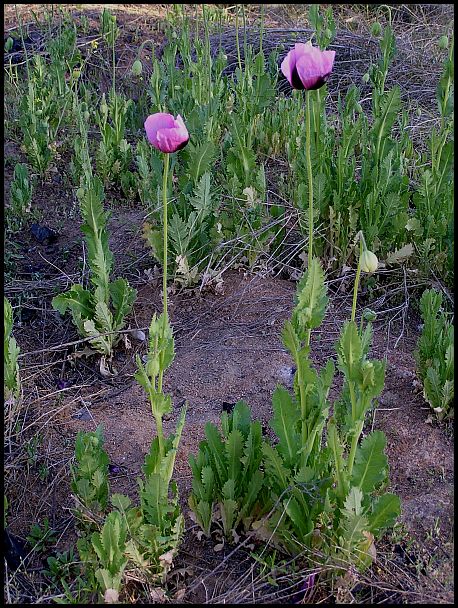
Papaver somniferum subsp. setigerum

4 large pinkish mauve petals with purple-black spots at the base

Introduced plant - origin: native of Europe and the Mediterranean

Family - Papaveraceae

Common name - Opium Poppy, Wild Poppy

Flowers and fruit -  Cup-shaped flowers, 4 paper thin pink to pale violet with purple-black spots at the base. Two hairy green sepals shed as the flower opens. The fruit is a hairless globose capsule 1 to 1.5cm wide with 7 or 8 ray-like ridges at the top. On maturity, pores beneath the ridges open, releasing the seeds. Flowering period is spring.

Leaves and stems - Leaves are spear-shaped with toothed margins, a basal rosette and stem-hugging leaves higher on the plant. Leaves are light green to blue-green with scattered hairs. Stems have long stiff white hairs.

Habit and habitat - Papaver somniferum subsp. setigerum is a bluish-green fast growing erect annual herb up to about 1mt tall, but more often to 70cm. It is a widespread weed on roadsides and disturbed areas.
Stiff white hairs on stems

Growth habit of Papaver somniferum subsp. setigerum

Pittosporum angustifolium

The conspicuous split fruit and red seeds of Pittosporum angustifolium


Previous name - Pittosporum angustifolium was formerly referred to Pittosporum phylliraeoides, a species now recognised as being restricted to coastal sites in the Dampier Archipelago to the Kalbarri region in Western Australia. Pittosporum angustifolium is mainly an inland tree and is widespread across much of Australia.

Family - Pittosporaceae

Common name - Weeping Pittosporum, Butter Bush

Flowers and fruit - Cream to pale yellow tubular flowers about 8mm across the mouth of the petals, in axils or terminal clusters.  Flowering period is winter and spring. Seed capsule is globose (round), smooth, yellow and 8 to 18mm long. The fruit is depressed vertically around the centre, splitting in two when ripe, to reveal red sticky seeds. When the tree is in fruit, the yellow capsules are very conspicuous.

Leaves and branches - Leaves are alternate, long and narrow 4 to 12mm wide and 4 to 12cm long, with a weeping habit. Outer and thin branches also have a weeping habit.

Habit and habitat - Pittosporum angustifolium is a shrub or tree to about 10mt high, almost glabrous (hairless) throughout, with a weeping habit. It grows in dry woodland communities.

Plentiful flowers of Pittosporum angustifolium

Tubular flowers in leaf axils

Weeping leaves of Pittosporum angustifolium

Distinctive fruit with vertical central depression

A 2mt Pittosporum angustifolium flowering

Isopogon petiolaris

Distinctive flowers of Isopogon petiolaris (Spreading Cone Bush)

Family - Proteaceae

Common name - Spreading Cone Bush, Drumsticks

Flowers and fruit - Flowers are carried in terminal yellow globular clusters, larger than 2cm diameter. Flowers are conspicuous and followed by rounded cones. Isopogon petiolaris can flower any time in spring and summer.

Leaves - Light green leaves are deeply lobed, stiff with a sharp point, and up to 15cm long. The leaf stalk is up to 9cm long and is two-thirds of the leaf length.

Habit and habitat - A low mounded ground cover to upright shrub less than a meter tall. Isopogon petiolaris is an eye-catching plant when flowering. It grows in dry sclerophyll forest and heath, commonly in stony sites. In The Pilliga it can occur in dry sandstone country.

Flowers, fruit and leaves of Isopogon petiolaris

Spreading habit of Isopogon petiolaris

Solanum cinereum

Spines and woolly purple hairs on inflorescences

Family - Solanaceae

Common name - Narrawa Burr

Flowers and fruit - Flowers are mauve to purple, in groups of 2 to 7, about 35mm across, with spines on stalks and calyx - can also have dense woolly purple hairs on inflorescences and upper stems. The dark brown globular fruit is usually between 15 and 20mm diameter. Main flowering time is January to April, but flowers can occur at any time.

Leaves and stems - Dark green shiny leaves are irregularly shaped and up to about 12cm long. The underside of leaves is white to pale yellow and densely hairy. There are spines on all parts of leaves and stems of Solanum cinereum.

Habit and  habitat - An erect or bushy, prickly undershrub to about 1mt tall, and can occur singly or in colonies. Grows in a variety of habitats, commonly in Eucalypt forest or disturbed areas.
 
Shiny, prickly leaves and stems of Solanum cinereum

Large, dark brown fruit of Solanum cinereum

Understory habitat of Solanum cinereum

Solanum ferocissimum

Flowers and spines of Solanum ferocissimum

Family - Solanaceae

Common name - Spiny Potato Bush

Flowers and fruit - Flower of Solanum ferocissimum is 15 to 20mm diameter, and has 5 white to pale blue triangular petals and prominent yellow stamens. Globular fruit is 5 to 8mm diameter, shiny red to almost black. Flowers throughout the year.

Leaves and stems - Shiny green leaves are narrow, 3 to 6cm long, with upper surface sparsely hairy and lower surface densely hairy. There are spines along the central upper vein of leaves. Prickles are abundant on the stems, but absent from inflorescences.

Habit and habitat - Solanum ferocissimum is an erect, spiny plant to 1mt high growing in colonies. Colonies of Solanum ferocissimum grow in sclerophyll forests in a variety of situations. It is a common plant.
My thumbnail gives a size comparison to the orange-red globular berry

Leaves, spines and fruit of Solanum ferocissimum

Tuesday, June 25, 2013

Hardenbergia violacea

Attractive flowers of Hardenbergia violacea in The Pilliga

Family - Fabaceae (Faboideae)

Common name - Purple Twining Pea, False Sarsaparilla

Flowers and fruit - Flowers are violet with a yellow centre, and are borne in racemes which are often very numerous and conspicuous making it an attractive bush plant. Seed pod is up to 45mm long, and maturing to dark brown. Flowering mostly in spring.

Leaves - Leaves are alternate, simple (not divided into 3 leaflets like other twining pea-flowers), firm, broadly ovate, strongly veined and up to about 9cm long.

Habit and habitat - Hardenbergia violacea is a common and vigorous twiner found in a variety of habitats and soil types. It may be a wiry trailing plant with long stems which twist through the undergrowth, over rocks and roadside banks, or it may scramble over shrubs and ascend small trees.

Numerous flowers and vigorous climbing habit of Hardenbergia violacea

Prominent veins in leaves, and dark brown seed pods

Hardenbergia violacea scrambles over shrubs

Geijera parviflora

Bushy habit of Geijera parviflora (Wilga) in The Pilliga

Family - Rutaceae

Common name - Wilga

Flowers and fruit - Flowers are about 5mm diameter, have 5 tiny white/cream triangular petals 1.5 to 2mm long, on racemes 4 to 7cm long. Fruit is spherical, 4 to 5mm diameter, with a single black seed protruding when the capsule splits in half. Flowers from Jun to Nov, and at other times.

Leaves and stems - Leaves are linear, up to about 18cm long, less than 1cm wide, with midrib raised on lower surface. Shrub or tree to 10mt high, pale and dark grey blotched stems.

Habit and habitat - Leaves and branches of Geijera parviflora are pendant, usually reaching the ground, but frequently trimmed by sheep. Wilga grows in mixed woodland communities and is very common in The Pilliga, widespread and easily recognised by it's bushy, weeping habit.

Long, narrow leaves of the Wilga

Tiny flowers of the Wilga are prolific but not easily noticed

Globose fruit splits in two revealing one black, shiny, crinkled seed

2-tone grey stems are usually hidden by weeping foliage

Hybanthus monopetalus

Hybanthus monopetalus in The Pilliga

Family - Violaceae

Common name - Slender Violet

Flowers - Flowers are borne on racemes on long stalks at the end of stems or in axils. The conspicuous lower petal is blue-mauve 7 to 20mm long, and the upper petals are minute (2 to 3mm). Flowering period is summer. The round seed capsule is 3 to 6mm wide.

Leaves and stems - This slender plant has weak stems up to 60cm tall. Narrow leaves are widely spaced along the stems, slightly recurved, opposite on the upper plant.

Habit and habitat - Hybanthus monopetalus is a spindly perennial herb that is rarely noticed when not in flower. It grows mostly on sandy soils or rocky outcrops in dry sclerophyll forest. It also occurs in Qld, Vic and SA.

Long, narrow, slightly recurved leaves of Hybanthus monopetalus

Fruit of Hybanthus monopetalus

Thursday, June 20, 2013

Acacia deanei ssp paucijuga

Acacia deanei subsp paucijuga

Family - Fabaceae (Mimosoideae)

Common name - Deans Wattle

Flowers and seed pods - Inflorenscences in terminal and axillary racemes, 15 to 30 flowered, about 5.5mm diameter, pale yellow to yellow. Pods are straight to curved, slightly to deeply and often irregularly constricted between seeds up to 18cm long and between 5.5 and 11mm wide. Flowering Sept/Oct. Acacia deanei subsp. paucijuga is a showier plant in flower than Acacia deanei subsp. deanei, but less free-flowering.

Leaves - Grey-green bipinnate leaves (central stem from which pairs of leaflets which are themselves divided into tiny leaf segments). One raised yellowish gland at the base of the bipinnate leaflet. Leaves are wider and more robust than Acacia deanei subsp. deanei, making the two subspecies easy to separate in the field.

Habit and habitat - A spreading to erect shrub from 1.5 to 7m high with smooth green or greyish branches. Grows on a variety of soil types in sclerophyll forests or open woodland.

Grey-green bipinnate foliage of A. deanei ssp paucijuga

Opened pods of Acacia deanei ssp paucijuga

Showy habit of Acacia deanei ssp paucijuga

Habitat of Acacia deanei ssp paucijuga in The Pilliga

Compare with Acacia deanei subsp. deanei here.

Jacksonia scoparia

Jacksonia scoparia

Family - Fabaceae

Common name - Dogwood

Flowers and fruit - Flowers are orange-yellow with red centres on terminal racemes in upper axils. The calyx is 5-lobed reddish-brown and covered with silky hairs. The seed pod is oblong-elliptic, 6 to 12mm long, flattened, reddish-brown and covered in long whitish hairs. Flowering Oct to Nov.

Leaves and stems- Leafless (leaves usually reduced to scales). Angular branches are minutely downy giving them a grey appearance.

Habit and habitat - A tall leafless shrub generally to 3m but can grow much taller. Branches are often drooping and bear a profusion of flowers, making Jacksonia scoparia very showy and noticeable. It grows on low-nutrient gravel or sandy soils in exposed positions and hillsides and ridges.

Leafless branches of Jacksonia scoparia (Dogwood)

Reddish-brown seed pods of Jacksonia scoparia covered in silky hairs

Drooping habit of Jacksonia scoparia on roadside

 
'Fascination' growing on Jacksonia scoparia

A 'fascination' is an abnormal growth in which the growing tip becomes elongated, flattened, ribbon-like, crested or elaborately contorted. More information here.